
Fire Resistance & Behaviour Testing
Due to the products and equipment they house, industrial facilities and logistics warehouses are particularly susceptible to fire and explosion risks. For this reason, product and equipment manufacturers must integrate these threats from their development phase. Similarly, safety managers must consider the fire behavior of certain stored materials during their operational phase and ensure fire training for their employees.
Understanding the risk is the most effective strategy; therefore, it is essential to study these behaviors to anticipate and control the threats they represent as efficiently as possible.
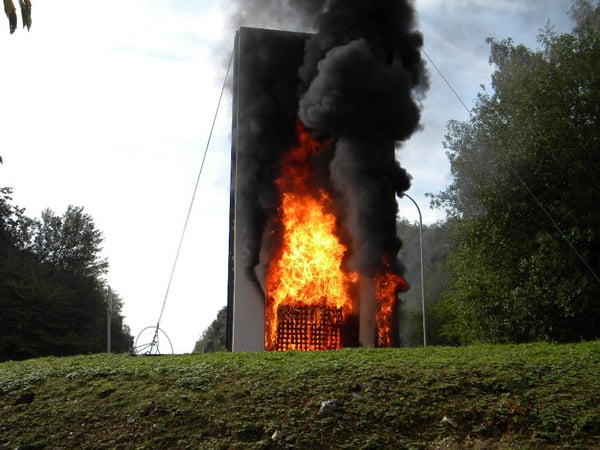
Importance and stakes of fire behavior testing
The fire behavior of products and goods operated by an industrial facility or logistics warehouse represents fundamental data for the prevention and control of fire and explosion risks. Indeed, it is crucial, and sometimes even regulatory, to study, analyze, and evaluate the potential fire behavior should an ignition occur within the premises where goods are manufactured, handled, and stored.
Given the varying behavior of fire depending on its context, several parameters must be considered. For instance, a fire in a warehouse storing tires will not behave the same way as one in a cosmetics factory. The attributes and characteristics of the products and premises will significantly influence the evolution and propagation of flames.
Understanding to better prevent fire risk
By achieving a better understanding of fire and its behavior, professionals can establish prevention plans, adapt manufacturing and storage processes, and, critically, integrate the inherent fire risk comprehensively. To this end, our experts conduct tailor-made tests on all types of fires (storage fires, lithium-ion battery fires, etc.) to evaluate the performance of design solutions and quantify the effects of various fires within the scope of fire safety engineering studies.
Abuse Testing on Lithium Batteries
The fire resistance test, as per Annex 9E of UNECE Regulation R100 (United Nations Economic Commission for Europe), verifies a battery's resistance to an external vehicle fire, for example, following the ignition of a fuel spill. The product's fire behavior must allow the driver and passengers sufficient time for safe evacuation.
The protocol involves exposing the product to an open-burning automotive gasoline fire for 70 seconds, followed by a fire of the same nature and surface area but reduced in power by means of an intermediate perforated brick screen for 60 seconds.
Monitoring is carried out to record any potentially dangerous events during fire exposure and subsequent cooling, such as molten material projection, fireball, flaming gas jet, explosion, etc.
En savoir plus sur les risques liées aux batteries lithium
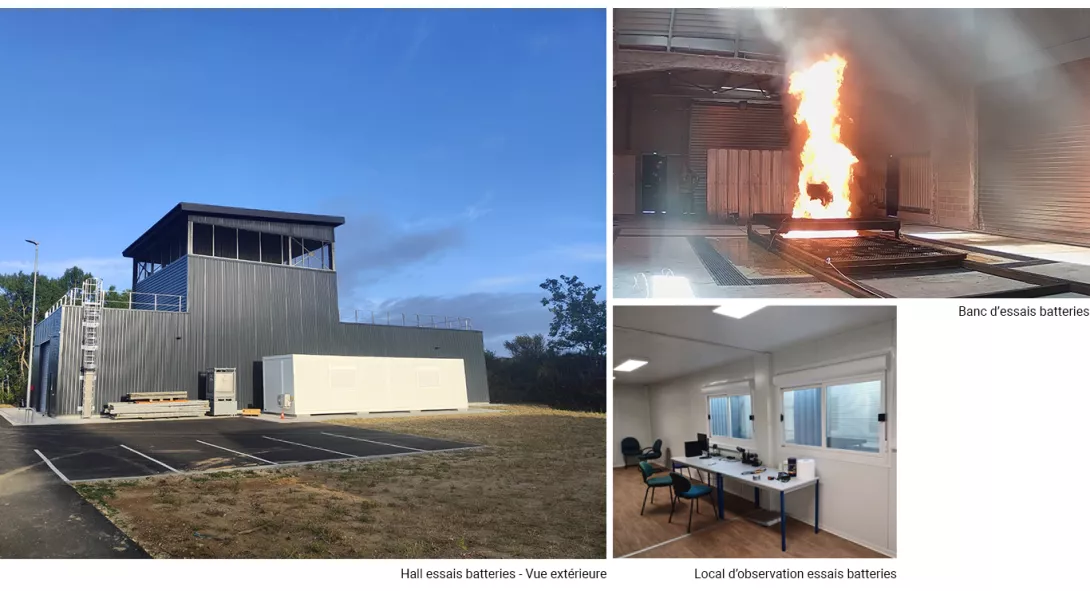
We have been conducting tests for many years for major French automotive players as well as international lithium battery stakeholders, as part of product development or homologation projects in collaboration with the Utac group.
High-Power Lithium Battery Abuse Test Scenarios:
- Overcharge
- Thermal runaway
- Fuel fire resistance (R100, Annex 9E)
- External short circuit
Expertise and Unique-in-Europe Testing Facilities for Analyzing the Fire Behavior of Your Products
CNPP supports industrial manufacturers and logistics warehouse operators in integrating fire and explosion risks through a multitude of testing facilities, as well as via the execution of tests and the development of adapted evaluation methodologies.
We are capable of providing an appropriate and tailor-made response to your activity, product nomenclature, and specific issues through three categories of studies:
- Implementation of experimental tests on your products to analyze fire behavior.
- Performance of tests according to your test protocol.
- Development of an evaluation methodology, developed by CNPP or in collaboration with the client.
Why conduct fire tests?
- To understand how your system or product reacts in a fire.
- To define extinguishing solutions adapted to your projects.
To validate the effectiveness of extinguishing agents or innovative extinguishing systems.
A methodology implemented by our experts, unfolding in 3 stages:
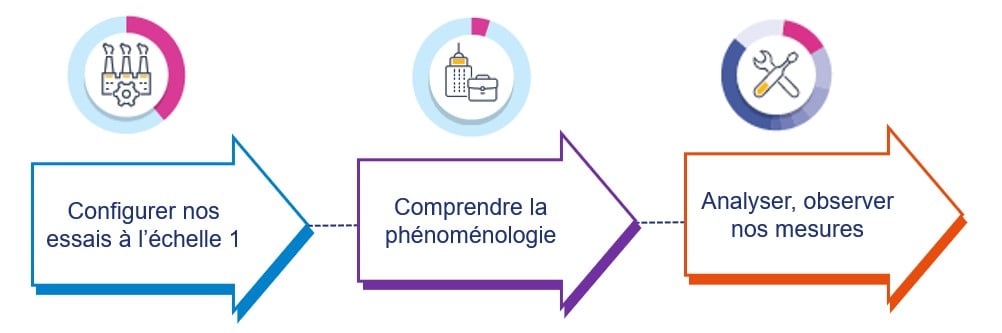
To be efficient, this methodology relies on a team of over 30 experts, predominantly mechanical profiles, along with chemists, project managers, modeling engineers, customer service, and managers.
A Range of Unique-in-Europe Facilities
Calorimetric Hood Tests
Determining the heat release rate of a fire is a frequently expressed requirement in fire safety professions. To address this, we possess a calorimetric hood capable of characterizing the combustion of large-scale equipment, such as vehicles, or bulk storage of finished products or raw materials.
Tests can be performed under free combustion conditions (simulating fire ignition) and forced combustion conditions (simulating the combustion of the element in the fire phase).
Why Conduct Calorimetric Hood Tests?
- Evaluate the heat release rate and combustion duration of a specific product palette.
- Integrate particular components not present in existing databases.
- Gain a better understanding of the fire behavior of stored products.
- Optimize the effect distances of radiated thermal fluxes calculated by the FLUMILOG tool.
- Demonstrate non-combustibility in the context of section 1510 ("incombustible protocol").
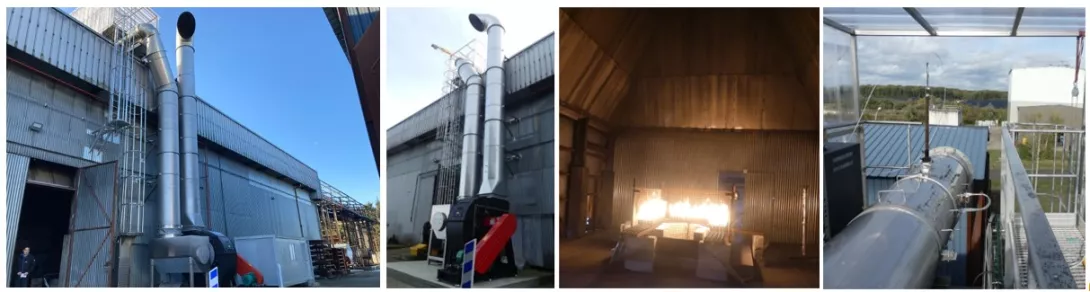
Several test halls, including one with a unique-in-Europe movable ceiling
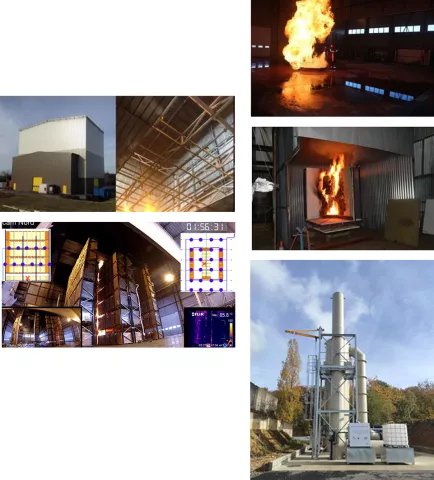
5 fire halls, including:
- The largest fire hall in Europe, accommodating all types of fire scenarios and setups, featuring a movable ceiling for water-based extinguishing system tests (up to 12m).
- A hall with smoke treatment, enabling the neutralization of emissions during the complete burning of batteries before their evacuation from the site.
Oven for Heat Resistance Testing
Among our numerous testing facilities, we test the heat resistance of many products using custom-built ovens designed according to specific needs. These pieces of equipment allow for standardized or customized thermal programs with variable temperature ramp rates up to 1200°C.
I wish to conduct fire behavior tests
Specific Tests
Tests on raw material or finished product storage
For many years, we have been involved in the development and execution of fire behavior tests related to the risks associated with raw material or finished product storage. Our testing capabilities allow for full-scale tests: complete storage setups, mock-ups, etc.
We conduct tests in our dedicated infrastructures on the main types of finished product storage in order to:
- Evaluate extinguishing means.
- Study non-combustibility for the purpose of exclusion from ICPE (Installations Classified for Environmental Protection) section 1510.
This video was recorded during the "Sprinklers: understanding innovations to make the right choices" conference on 09/18/2014. It demonstrates our testing capabilities for a sprinkler extinguishing system on high-rack storage.
A stack of cardboard box pallets was created on a modular metal structure with a total height of 9m. A second stack was placed nearby to simulate a target across a warehouse aisle.
The ceiling of our test hall, whose height is adjustable between 3m and 12m, features a network of 36 sprinklers (3m x 3m grid), with the model chosen before the test. Fire ignition is typically achieved by igniting a hydrocarbon-soaked cotton ball enclosed in a plastic bag. The ignition device is installed at the base of the storage. The water supply pressure to the sprinkler network, adjustable between 1 and 9 bar, is regulated to produce the desired discharge density, and all extinguishing water is collected in channels for buffer retention before treatment in the site's wastewater treatment plant. Sprinkler activation is visually monitored. This activation is confirmed by temperature measurements near each head, which is highly useful in case of visibility loss due to significant smoke production, complemented by infrared thermal video.
Fire behavior in hydrocarbon fires
We conduct hydrocarbon fire tests in basins capable of producing a fire surface of up to 200 m². These tests allow, among other things, for understanding the fire behavior of certain road vehicles such as tankers (ADR regulatory test on tankers), as well as testing flammable liquid products.
Other tests can be conceived on our site
Fire behavior tests on power transformers
Our experts also conduct tests on power transformers (IEC 60076-11) in a test cabin described in standard IEC 60332-3-10. This involves subjecting a complete transformer phase (cylindrical HV and LV coils) to an ethanol fire and radiation from a radiant panel.
Explosion Resistance Tests for Bank Safes
CNPP utilizes gaseous and solid explosives to test the resistance of bank safes (EN1143-1 and -2) and the effectiveness of banknote staining systems.

We are available to conduct specific tests on your products.
Contact Us!