
Engineering for fire safety, smoke control and evacuation
Fire Safety Engineering (FSE) is an approach that aims to evaluate the performance of a design solution by quantifying the effects of a fire, with the objective of achieving defined safety goals (safe evacuation of occupants, intervention by emergency services for rescue purposes, structural fire stability, protection of third parties and the environment, etc.).
This performance-based approach allows for the analysis of solutions that are alternatives to regulatory requirements, taking into account implemented technical and organizational provisions.
3D modeling is utilized to assess the performance of various solutions.
Do you require a specific fire engineering study to meet the requirements of the Decree of April 11, 2017?
Numerical simulations of fire development, smoke behavior, and structural behavior (stability, failure modes) enable the assessment of whether fire dynamics are compatible with occupant evacuation and emergency service intervention.
They also determine if the proposed construction provisions prevent the failure of an element (wall, roof, columns, beams, mezzanines) due to an incident from leading to progressive collapse or an outward structural collapse.
These simulations are implemented to address, in particular:
- The requirements of Article 7, Annex II of the Decree of April 11, 2017, concerning large buildings (floor area > 12,000 m² and building height > 23 m).
- At a minimum, the requirements of Article 4, Annex II of the Decree of April 11, 2017, related to the addition of interior mezzanines. The absence of hindrance to smoke extraction must be demonstrated.
Image
| Image
|
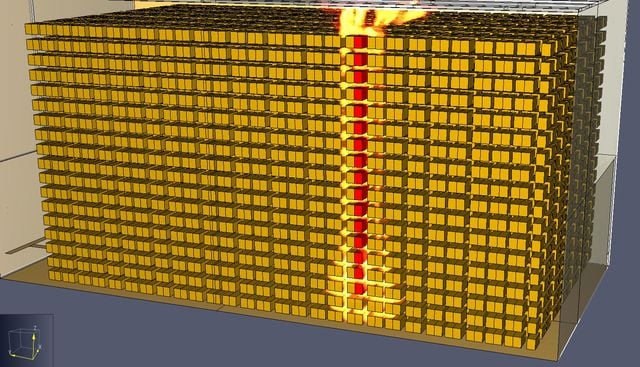
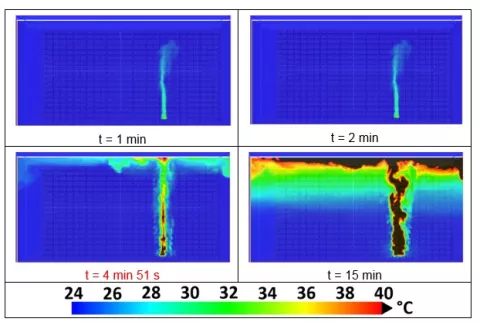
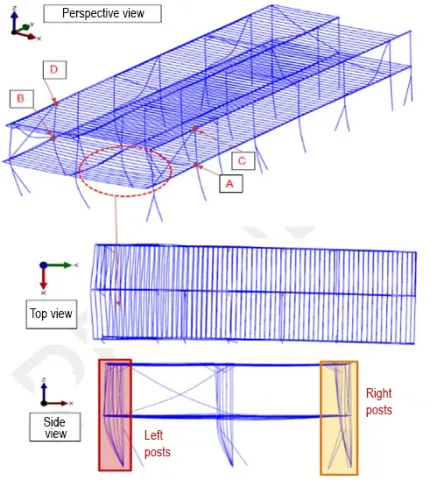
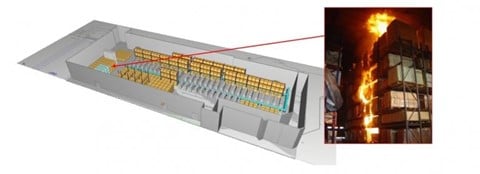
Study of a 40-meter high automated storage and retrieval system (AS/RS)
Image
| Image
|
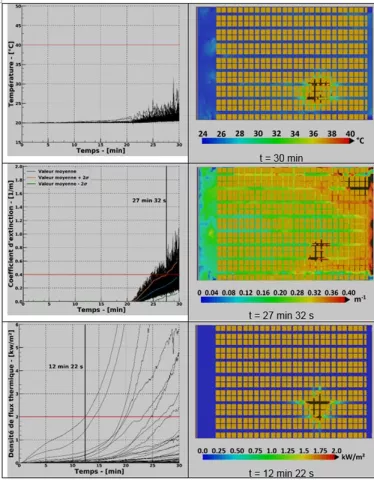
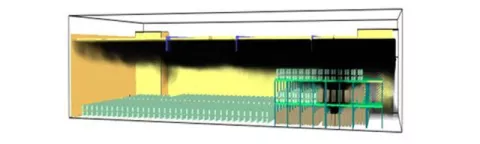
Engineering study for a mezzanine project on the second floor (R+2)
The effectiveness of the proposed smoke control system will be evaluated based on several performance criteria.
Simple vulnerability criteria will be used to assess tenability conditions for personnel (heat fluxes below 2 kW/m², temperature below 40 °C, and extinction coefficient below 0.4 m⁻¹, measured at a height of 2 m), intervention conditions (heat fluxes below 5 kW/m² and temperature below 100 °C, measured at a height of 1 m), or the intrinsic performance of smoke extraction (smoke propagation, hot layer temperatures, flashover risk).
Do you need technical elements to support a derogation request?
When appropriately applied, engineering can provide technical justifications to support a request for derogation from regulatory requirements, particularly for existing buildings.
The objective will be to verify if existing provisions are compatible with safety objectives, prior to incurring significant compliance costs (e.g., presence of asbestos on the roof).
Concrete application cases: smoke extraction deficiency (e.g., effective exhaust area (SUE) of 1% instead of the regulatory 2%), non-compliant smoke barrier height, mechanical smoke extraction for a windowless compartment.
Do you need technical elements to justify the fire stability of a structure or an interior fit-out? Or to demonstrate the absence of progressive collapse or outward collapse?
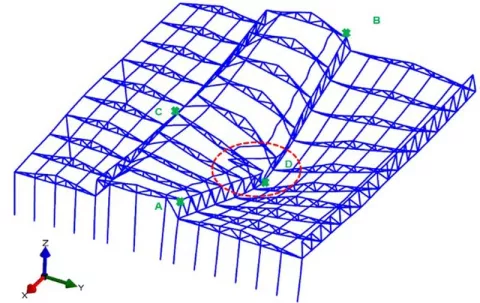
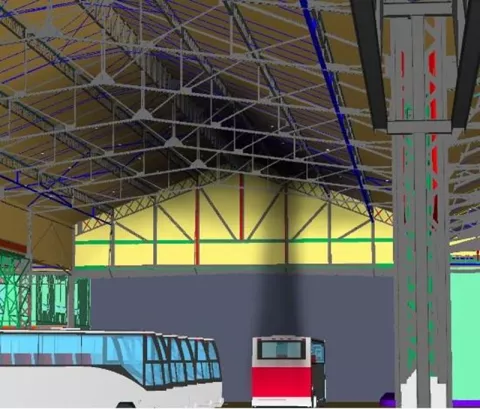
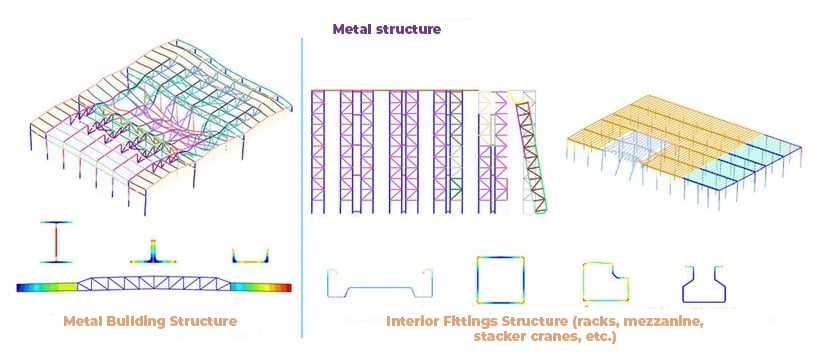
Thanks to advanced thermomechanical calculation models and CFD numerical simulation tools, we can model the mechanical behavior of various structures exposed to fire (steel, reinforced/prestressed concrete, timber, composites).
Image
| Image
|
We can assist you with:
- Analyzing the fire performance (R E I) of structural elements under standardized fires (ISO 834 fire, HCM, external fire, etc.).
- Evaluating the real fire resistance (stability) of building structures (buildings, infrastructures) or interior layouts (single or multi-level mezzanines, racks, automated storage and retrieval systems).
- Studying failure modes (absence of outward collapse and progressive collapse).
- Studying the reinforcement and optimization of fire resistance; evaluating the impact of compensatory measures (passive protection such as sprayed fireproofing, intumescent paint, encasement, or reinforcement by adding structural elements).
Do you require technical assistance for post-incident expertise through 3D modeling?
For every issue related to fire, we can offer a technical assistance study through modeling, tailored to your needs and objectives.
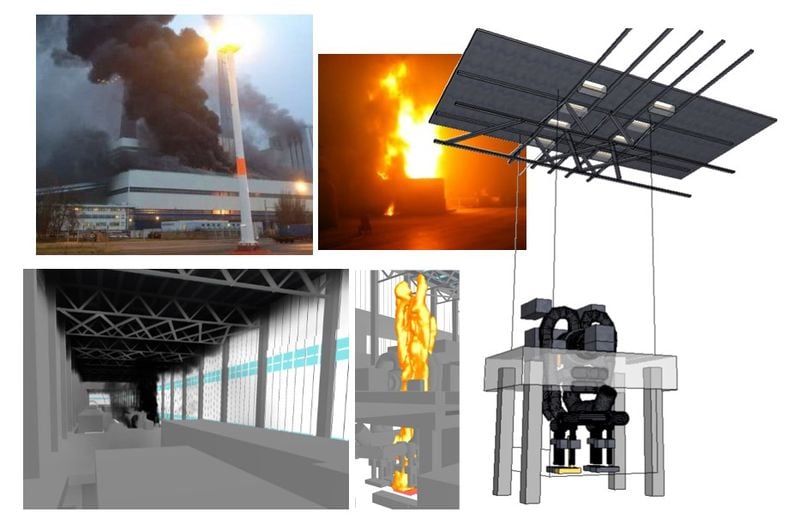
In support of Fire Cause and Circumstance Investigation (FCCI), numerical simulation is an expert assessment tool that provides objective technical elements to:
- Confront different hypotheses.
- Evaluate specific parameters (thermal stresses, ventilation).
- Determine the most plausible scenario based on observations or events noted on site.
Our approach is built upon field experience (FCCI unit and full-scale test facility for 50 years).
We offer a proven approach, adhering to best practices, which promotes communication and support at every stage.
Our approach is based on 70 years of expertise, fire behavior testing, and R&D to characterize the fire performance of products.
We deploy powerful and tailored simulation tools, utilized by our experts specializing in industrial risk management. Raise awareness among yourself and your teams about fire detection to prevent the possibility of a fire as early as possible.

We are available to assist you with your project.
Contact us!