Batteries: A New Testing Infrastructure at CNPP
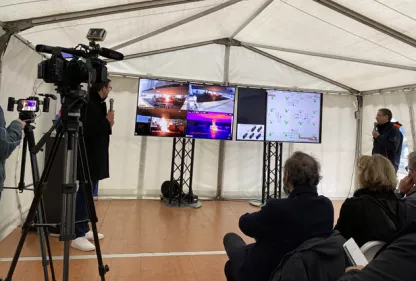
CNPP inaugurated a brand-new Battery test hall on Friday, 24 October 2025, in the presence of representatives from the prefecture, DREAL Normandie, ADEME (the French Environment and Energy Management Agency), and CNPP’s Board of Directors.



Driven by Europe’s decarbonization objectives (including the ban on sales of internal combustion vehicles by 2035), the automotive industry is undergoing a major transformation with the rise of electric vehicles (EVs). Supported by environmental imperatives, government incentives, and advances in technology, this transition is accelerating significantly. In 2015, electric vehicles represented approximately 1 % of new car registrations; by 2024, this share exceeded 17 %, with the electric fleet now surpassing 1.5 million units. These figures highlight a profound shift in the French automotive landscape toward more sustainable mobility.
Alongside this transformation, risks are evolving, and the number of incidents involving EVs is increasing.
In this context, CNPP inaugurated its new Battery test hall on 24 October 2025 with participation from the prefecture, DREAL Normandie, ADEME, and CNPP’s Board. This testing infrastructure aligns with CNPP’s core mission of risk prevention and control and reinforces the range of solutions CNPP offers to manage risks associated with new energy technologies and mobility.
Long-standing Lithium-Ion Battery Testing Activities
Gathered around Guillaume Savornin, CEO, and Patrick Degiovanni, President of CNPP, the Fire & Environment Laboratory teams presented the projects they have undertaken to support manufacturers in managing the risks associated with new battery technologies.
For many years, CNPP has conducted abusive tests on lithium-ion batteries, including:
- External fire exposure tests
- Thermal propagation due to internal heating or overload
- External short-circuit tests
- Electrical overcharge/over-discharge tests
A New Testing Environment
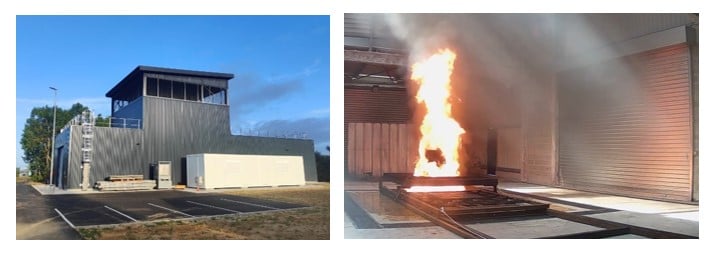
This new testing environment is entirely dedicated to external fire exposure tests on batteries.
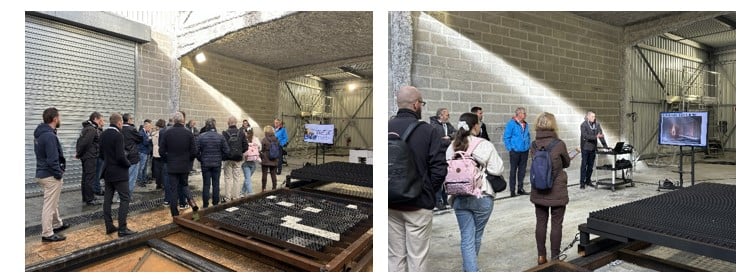
Key technical characteristics of this facility include:
- Total surface area: 300 m²
- Height above the fire zone: 10 m
- Fire power: up to 18 MW
- Two large remote-control sectional doors
- Refractory brick floor at the fire location
- Thermal protection of structural elements
- Electrical power supply capable of charging batteries up to 120 A
- Natural smoke extraction area of 40 m²
- Observation and measurement monitoring room with direct visualization
- Collection system for rinse water for treatment
Designed for testing car batteries, this hall can also be used for other types of fire tests. Its highly modular structure allows adaptation to custom protocols while remaining sheltered from weather conditions.
Complemented by an Innovative Smoke Treatment System
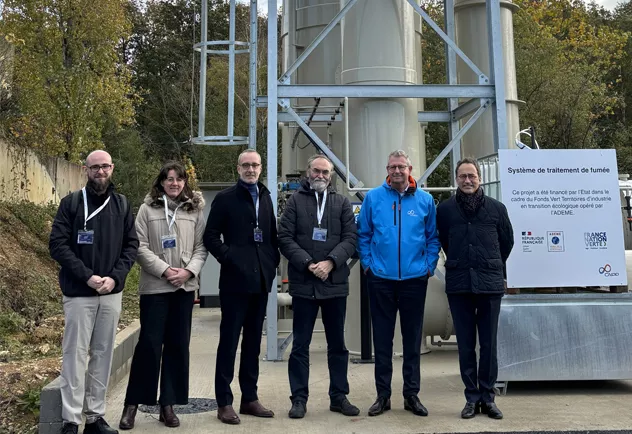
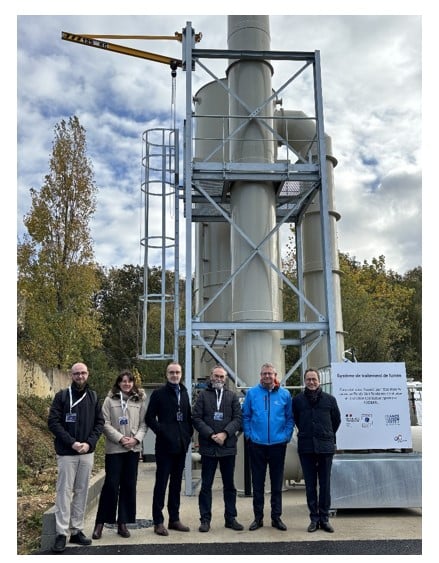
This system enables the complete neutralization of batteries by controlled burning after testing. This step is essential to safely transport the tested battery to a recycling facility.
The system includes an extraction hood under which the battery is exposed to a flame fed by gas, as well as a smoke scrubber that treats emissions.
This smoke treatment system was financed by the State under the Green Fund for Industrial Territories in Ecological Transition, operated by ADEME.